
English| EUR
Suggested for you
More currencies
Choose a language
Interlaken sits at 568 meters in a glacial valley between two alpine lakes, where snow behaves very differently than on the peaks above. The town itself rarely holds deep snow for long, while the surrounding mountains maintain winter coverage well into spring. This guide answers whether snow is present right now and explains the seasonal patterns that shape what you'll find.
Quick answer
As of August 2026, there is no snow in Interlaken town—the valley floor is snow-free from late April through October. However, the high-altitude destinations above Interlaken, including Jungfraujoch at 3,454 meters and Schilthorn at 2,970 meters, maintain year-round snow and glacier coverage. Mid-December through March offers the most reliable valley snow, though accumulation at 568 meters elevation is sporadic and often melts within days.
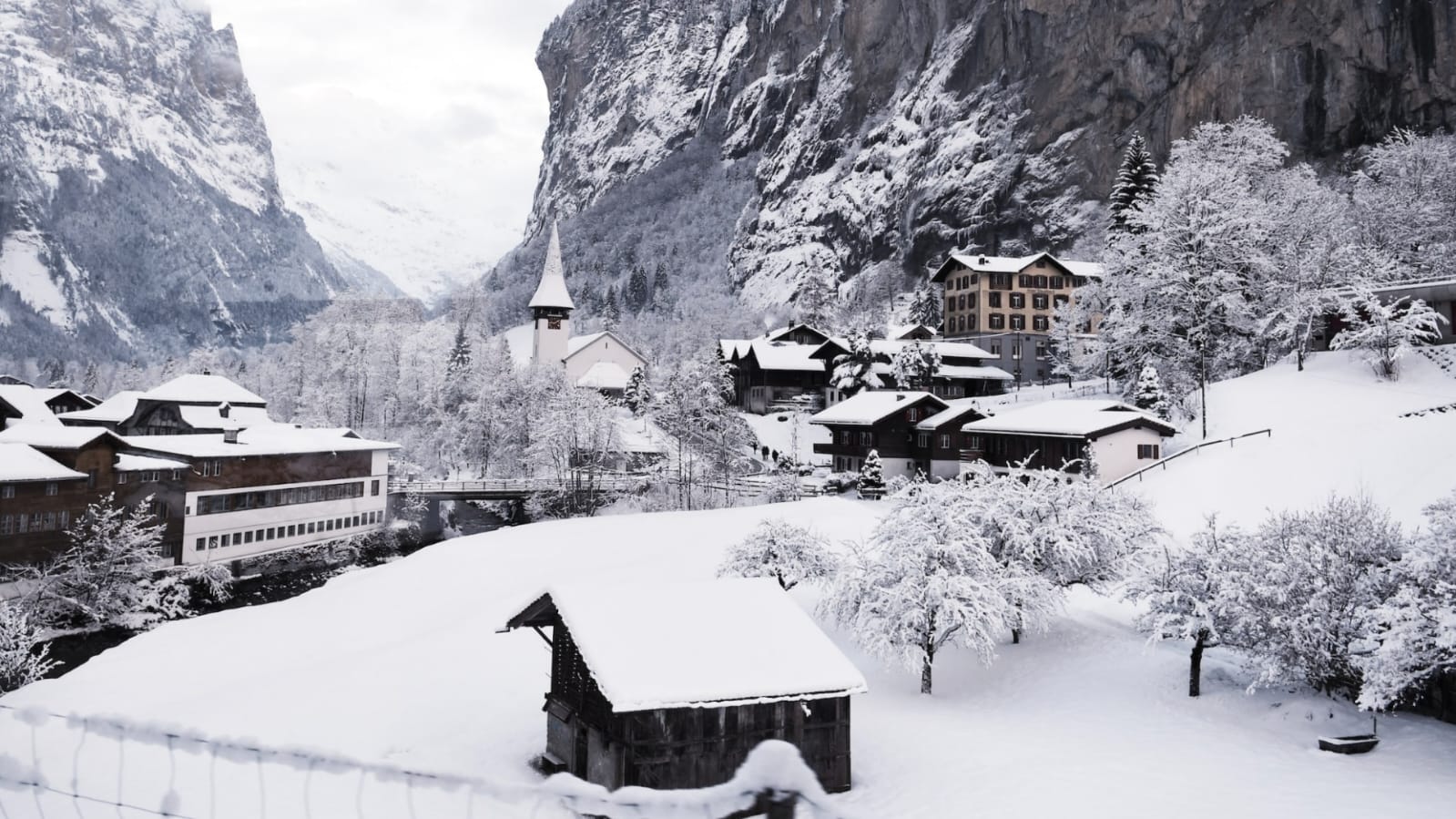
Interlaken's position at the threshold between lowland and alpine creates a snow gradient steep enough to measure in hundreds of meters. The town occupies the Bödeli, a flat alluvial plain where the Aare River links Lake Thun and Lake Brienz, and winter temperatures hover near freezing rather than plunging into the deep cold that locks snow in place. A January morning might bring five centimeters of powder that turns to slush by afternoon, while the same storm deposits half a meter on Grindelwald, just fifteen kilometers south and 465 meters higher. Current Interlaken snow conditions in August show bare ground across the valley, with the tree line and hiking trails fully accessible. The glaciers and permanent snowfields of the Jungfrau massif remain visible from Höhematte park, a reminder that altitude, not latitude, governs snow presence in this region. Visitors expecting a snow-blanketed village throughout winter will find instead a transitional zone: rain is as common as snow between November and February, and sustained cover below 1,000 meters is the exception. The mountains above reverse the pattern entirely. Jungfraujoch, reachable by cogwheel railway from Kleine Scheidegg, reports snow depths between three and six meters year-round, with the Aletsch Glacier extending forty-one kilometers to the southeast. Schilthorn, accessed via Mürren, and Harder Kulm at 1,322 meters typically hold snow from November through April, though only the highest elevations guarantee coverage outside the core winter months. Day visitors seeking reliable snow conditions focus on these high-altitude destinations rather than the valley floor. Snowfall timing in Interlaken follows a predictable alpine rhythm: the first flakes arrive in the valley during late November, peak frequency runs from mid-December through February, and the last significant accumulation clears by early April. But frequency does not equal permanence—the town's relatively mild microclimate and frequent föhn winds mean that even midwinter snow often lasts only forty-eight to seventy-two hours before melting or compacting into ice. Those planning winter activities centered on snow should budget for the mountains, where seasonal reliability is measured in months rather than days.
“Altitude, not latitude, governs snow presence in this region—the town at 568 meters sees sporadic cover while peaks above 3,000 meters hold it year-round.”
The distribution of snow in the Interlaken region is primarily determined by significant variations in vertical elevation. While the valley floor often experiences temperate conditions, the surrounding peaks maintain alpine climates throughout the year.
The town of Interlaken sits at an elevation of 568 meters above sea level, which generally results in mild conditions compared to the nearby mountains.
The Jungfraujoch station, located at 3,454 meters, remains one of the highest points in Europe accessible by rail and features year-round snow cover.
The summit of the Schilthorn reaches 2,886 meters, providing a stark contrast in temperature and precipitation levels compared to the town below.
The region features a rapid vertical rise from the valley floor to the high-alpine peaks, driving the dramatic climate differences seen within a short travel distance.
Several glaciers, such as the Aletsch Glacier, are located in the high-altitude zones surrounding Interlaken and retain snow even during the warmest months.
The surrounding Bernese Alps act as a barrier that influences local weather patterns and determines where snow accumulation occurs within the valley and on the mountain slopes.
Interlaken serves as the primary transport hub for the Bernese Oberland. To reach high-altitude zones where snow may be present, visitors must transition from the town center to mountain rail and cable car networks.
Berner Oberland Bahn (BOB) from Interlaken Ost to Lauterbrunnen or Grindelwald
Wengernalpbahn or local cable cars toward Jungfraujoch or Schilthorn
Interlaken Ost or West station to local mountain railway terminals
The best arrival window is 09:00–17:00 to ensure optimal daylight for viewing surrounding mountain scenery. Utilize the Interlaken Ost station as your central hub for all connections to higher elevations.
The Interlaken information services are available throughout the week to assist with your travel inquiries and logistics planning.
Everything you need to know about is there snow in interlaken right now
As of August 2026, there is no snow in Interlaken town center. The region experiences warm summer temperatures during this time, and the valley floor remains free of winter precipitation.
While the town is snow-free, you can find high-altitude snow at nearby peaks like the Jungfraujoch. Visitors often take mountain railways from the valley to reach these permanent snowfields.
Snow in the town center typically occurs only during the coldest winter months, usually starting from late December or January. Most snow during these months remains light, as the town is situated at a lower elevation.
Since it is currently summer, there is no snow in Interlaken right now to support local skiing or sledding activities. Winter sports enthusiasts generally wait until the temperatures drop significantly toward the end of the year.
Current weather conditions in August are mild and sunny, meaning all mountain excursions and town attractions are fully accessible. There are no weather-related closures for standard sightseeing activities at this time.
The most reliable method to determine if there is snow in Interlaken right now is to check official webcams provided by the regional tourism office. These live feeds offer real-time views of the town and surrounding Alpine peaks.
Although seasonal activities like night sledding require colder conditions, the area offers many summer alternatives such as hiking, paragliding, and lake cruises. You can find detailed information on seasonal availability on the official visitor website.